The Candidate Sounds Perfect… But Is AI Answering for Them?
Remote interviews are great for convenience — and unfortunately, great for candidates who lean on AI tools during the conversation.
This isn’t about preparing with AI. Researching the company, practicing answers, or polishing a resume is normal.
The concern is real-time AI assistance — when the candidate is quietly feeding your questions into a tool and reading back the output.
AI can polish an answer.
It cannot fake lived experience.
As AI tools become more common, employers may need to adjust how they evaluate candidates in remote settings.
One Sign Means Nothing. A Pattern Means Ask Better Questions.
A pause, a glance away, or a stiff answer doesn’t mean someone is cheating.
People get nervous. Some are introverted. Some are neurodivergent. Some are speaking a second language.
The issue is patterns — when polished answers crumble the moment you ask for specifics.
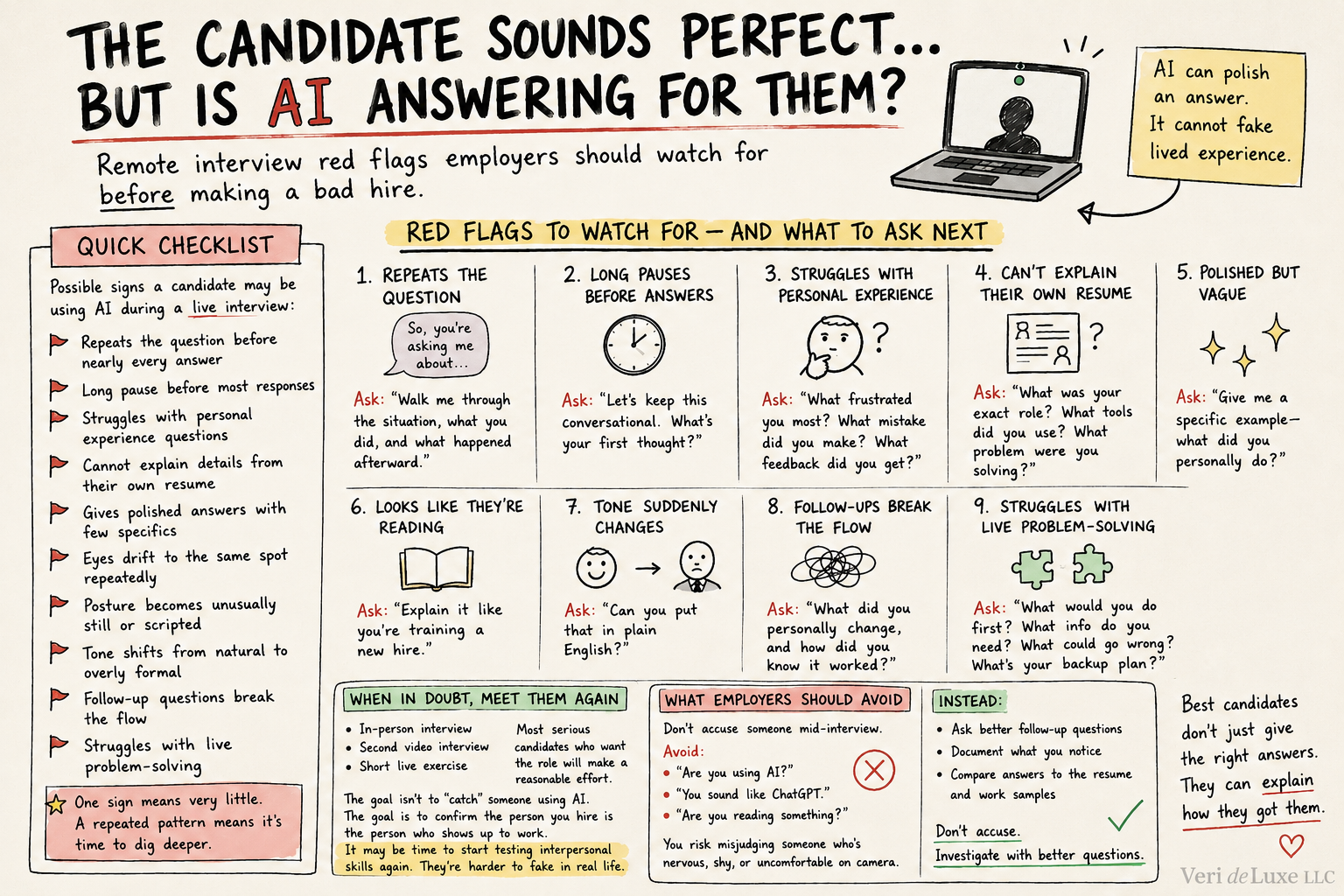
Quick Employer Checklist
Possible signs a candidate may be using AI during a live interview:
- Repeats the question before nearly every answer
- Long pause before most responses
- Struggles with personal experience questions
- Cannot explain details from their own resume
- Gives polished answers with few specifics
- Eyes drift to the same spot repeatedly
- Posture becomes unusually still or scripted
- Tone shifts from natural to overly formal
- Follow-up questions break the flow
- Struggles with live problem-solving
One sign means very little.
A repeated pattern means it’s time to dig deeper.
Red Flags to Watch For — And What to Ask Next
1. They Repeat the Question Before Answering
What it looks like:
They echo the question almost word for word.
Why it matters:
It can buy time for an AI tool to generate a response.
What to ask next:
“Walk me through the situation, what you did, and what happened afterward.”
2. Long Pauses Before Most Answers
What it looks like:
Several seconds of silence before nearly every response.
Why it matters:
Delays can come from transcription tools or hidden prompts.
What to ask next:
“Let’s keep this conversational. What’s your first thought?”
3. They Struggle With Personal Experience
What it looks like:
Strong general answers, weak personal ones.
Why it matters:
AI can fake a concept. It can’t recall their career.
What to ask next:
- What frustrated you most?
- What mistake did you make?
- What feedback did you get?
- What would you do differently now?
4. They Can’t Explain Their Own Resume
What it looks like:
They listed a skill or project but can’t explain it clearly.
Why it matters:
If it’s on the resume, they should be able to talk about it.
What to ask next:
- What was your exact role?
- What tools did you use?
- Who else was involved?
- What problem were you solving?
- What changed because of your work?
5. Answers Sound Polished but Vague
What it looks like:
Professional tone, zero specifics.
Why it matters:
AI answers often sound smooth but empty.
What to ask next:
“Give me a specific example — what did you personally do?”
6. They Look Like They’re Reading
What it looks like:
Eyes flick to the same spot, posture stiffens, rhythm becomes “read aloud.”
Why it matters:
They may be reading AI-generated text.
What to ask next:
“Explain it like you’re training a new hire.”
7. Their Tone Suddenly Changes
What it looks like:
Natural small talk turns into a corporate script once the interview starts.
Why it matters:
A sudden shift can signal they’re no longer speaking freely.
What to ask next:
“Can you put that in plain English?”
8. Follow-Up Questions Break the Flow
What it looks like:
Strong first answer, weak details.
Why it matters:
AI can give a headline. It can’t give the story.
What to ask next:
“What did you personally change, and how did you know it worked?”
9. They Struggle With Live Problem-Solving
What it looks like:
Great with rehearsed questions, shaky with real scenarios.
Why it matters:
Live thinking is harder to fake.
What to ask next:
- What would you do first?
- What information do you need?
- What could go wrong?
- What’s your backup plan?
When in Doubt, Meet the Candidate Again
If something feels off but you still like the candidate, invite them to:
- an in-person interview
- a second video interview
- a short live exercise
Most serious candidates who want the role will make a reasonable effort.
The goal isn’t to “catch” someone using AI.
The goal is to confirm the person you hire is the person who shows up to work.
It may also be time to start testing interpersonal skills again. Communication, adaptability, confidence, and real-time problem-solving are harder to fake when the conversation becomes more natural.
What Employers Should Avoid
Don’t accuse someone mid-interview.
Avoid:
- “Are you using AI?”
- “You sound like ChatGPT.”
- “Are you reading something?”
You risk misjudging someone who’s simply nervous, shy, or uncomfortable on camera.
Instead:
- ask better follow-up questions
- document what you notice
- compare answers to the resume and work samples
Don’t accuse.
Investigate with better questions.
Final Thoughts
AI is changing hiring — especially remote hiring.
Employers don’t need to become suspicious.
They need to become better interviewers.
Ask specific questions. Listen for real details. Use scenarios. Push past buzzwords. Make sure the candidate can explain the experience they claim.
AI can help someone prepare.
It shouldn’t be the one doing the talking.
The best candidates don’t just give the right answers.
They can explain how they got them.
Leave a Reply