Category: AI Prompts

  • Upgrade Your Affiliate Content: 7 Strategic AI Prompts

    Upgrade Your Affiliate Content: 7 Strategic AI Prompts

    7 AI Prompts for Affiliate Marketing Success

    Copy-and-paste prompts to find better affiliate cocntent ideas, improve old posts, discover affiliate programs, and focus on revenue instead of random traffic.

    Affiliate marketing gets messy fast. One minute you are writing a product roundup, and the next you are buried in keywords, Amazon links, Pinterest ideas, and advice that sounds helpful but does not lead to clicks.

    The problem is not always finding products. The problem is figuring out which content ideas are worth your time, which products fit naturally, and which articles have a real chance of turning into clicks, conversions, email signups, or revenue.

    That is where better AI prompts can help.

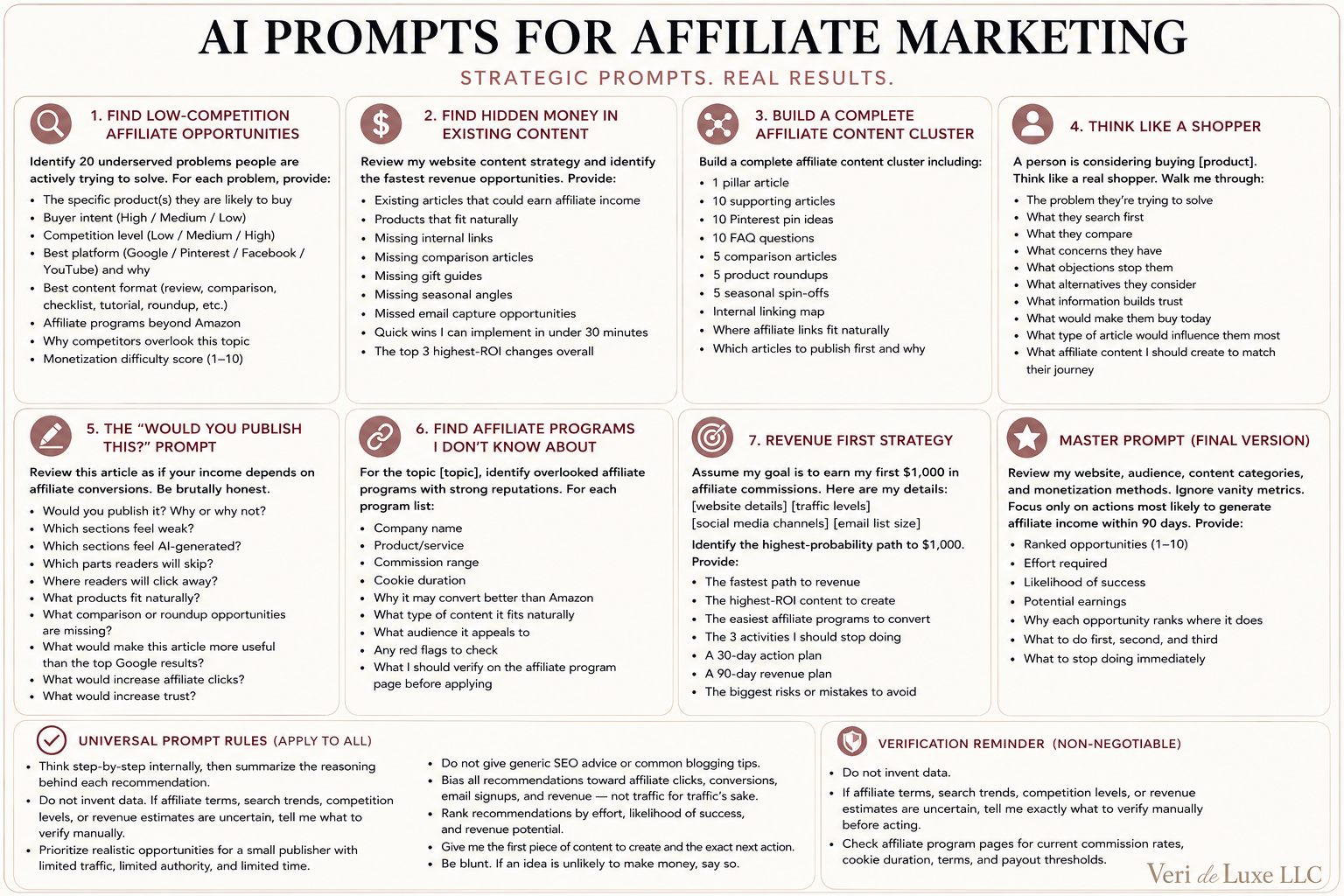
    Affiliate Marketing AI Prompt Cheat Sheet

    Save this prompt card for later, pin it to Pinterest, or bookmark this page so you always have the prompts handy.

    AI prompts for affiliate marketing success cheat sheet with seven prompt ideas for finding affiliate opportunities, improving content, building content clusters, thinking like a shopper, finding affiliate programs, and creating a revenue-first strategy.

    Prefer to copy and paste?
    The full text version of every prompt is included below so you can customize them for your niche, audience, website, and affiliate programs.

    Who These Affiliate Marketing Prompts Are For

    • Bloggers trying to monetize existing content
    • Pinterest creators looking for affiliate content ideas
    • Amazon Associates members who want more than random product links
    • Small publishers with limited traffic and limited time
    • Content creators building niche websites
    • Anyone trying to earn their first affiliate commissions

    Why Better AI Prompts Matter for Affiliate Marketing

    Generic prompts usually give generic answers. If you ask AI to “give me affiliate marketing ideas,” you may get the same recycled suggestions everyone else gets: write product reviews, make gift guides, post on Pinterest, and create high-quality content.

    That is not enough.

    Good affiliate content needs to connect three things:

    A real problem
    What is the reader trying to solve?
    A natural product fit
    What would genuinely help?
    A revenue path
    What could lead to clicks, trust, or sales?

    Copy-and-Paste Prompt Rule

    Add this rule to any affiliate marketing prompt when you want better answers:

    Think step-by-step internally, then summarize the reasoning behind each recommendation. Do not invent data. Prioritize realistic opportunities for a small publisher and bias everything toward clicks, conversions, email signups, and revenue.

    1. Find Low-Competition Affiliate Opportunities

    Use this prompt when you need new affiliate article ideas with real buyer intent.

    Prompt #1

    Act as a senior content strategist, SEO consultant, Pinterest marketer, affiliate analyst, and revenue-focused publisher.
    
    My website focuses on: [niche].
    
    Identify 20 underserved problems people are actively trying to solve. For each problem, provide:
    
    - The specific product(s) they are likely to buy
    - Buyer intent: High, Medium, or Low
    - Competition level: Low, Medium, or High
    - Best platform: Google, Pinterest, Facebook, or YouTube, and why
    - Best content format: review, comparison, checklist, tutorial, roundup, etc.
    - Affiliate programs beyond Amazon
    - Why competitors overlook this topic
    - Monetization difficulty score from 1 to 10
    
    Think step-by-step internally, then summarize the reasoning behind each recommendation.
    Do not invent data. If affiliate terms, search trends, or competition levels need verification, tell me what to verify manually.
    Prioritize realistic opportunities for a small publisher with limited traffic, authority, and time.
    Do not give generic SEO advice.
    Bias all recommendations toward revenue, not traffic.

    2. Find Hidden Money in Existing Content

    Use this prompt when you already have blog posts and want to find missed affiliate opportunities.

    Prompt #2

    Act as a conversion optimization expert, affiliate strategist, UX analyst, and revenue-focused publisher.
    
    Review my website content strategy and identify the fastest revenue opportunities. Provide:
    
    - Existing articles that could earn affiliate income
    - Products that fit naturally
    - Missing internal links
    - Missing comparison articles
    - Missing gift guides
    - Missing seasonal angles
    - Missed email capture opportunities
    - Quick wins I can implement in under 30 minutes
    - The top 3 highest-ROI changes overall
    
    Think step-by-step internally, then summarize your reasoning.
    Do not invent data. Tell me what to verify manually.
    Prioritize realistic opportunities for a small publisher.
    Do not give generic SEO advice.
    Bias everything toward clicks, conversions, and revenue.

    3. Build a Complete Affiliate Content Cluster

    Use this when you want a full content plan around one profitable topic.

    Prompt #3

    I want to dominate this topic: [topic].
    
    Build a complete affiliate content cluster including:
    
    - 1 pillar article
    - 10 supporting articles
    - 10 Pinterest pin ideas
    - 10 FAQ questions
    - 5 comparison articles
    - 5 product roundups
    - 5 seasonal spin-offs
    - Internal linking map
    - Where affiliate links fit naturally
    - Which articles to publish first and why
    
    Think step-by-step internally, then summarize your reasoning.
    Do not invent data. Tell me what to verify manually.
    Prioritize realistic opportunities for a small publisher.
    Do not give generic SEO advice.
    Bias everything toward revenue, not traffic.

    4. Think Like a Shopper

    Use this before writing a review, buyer guide, or comparison article.

    Prompt #4

    A person is considering buying [product].
    
    Think like a real shopper, not a marketer. Walk me through:
    
    - The problem they are trying to solve
    - What they search first
    - What they compare
    - What concerns they have
    - What objections stop them
    - What alternatives they consider
    - What information builds trust
    - What would make them buy today
    - What type of article would influence them most
    - What affiliate content I should create to match their journey
    
    Think step-by-step internally.
    Do not invent data. Tell me what needs verification.
    Prioritize realistic opportunities for a small publisher.
    Bias everything toward conversions and trust-building.

    5. The “Would You Publish This?” Prompt

    Use this before publishing an affiliate article so you can catch weak spots before readers do.

    Prompt #5

    Review this article as if you were a publisher whose income depends on affiliate conversions. Be brutally honest.
    
    Tell me:
    
    - Would you publish it?
    - Why or why not?
    - Which sections feel weak?
    - Which sections feel AI-generated?
    - Which parts readers will skip?
    - Where readers will click away?
    - What products fit naturally?
    - What comparison or roundup opportunities are missing?
    - What would make this article more useful than the top Google results?
    - What would increase affiliate clicks?
    - What would increase trust?
    
    Think step-by-step internally.
    Do not invent data.
    Prioritize realistic improvements for a small publisher.
    Bias everything toward revenue, not traffic.

    6. Find Affiliate Programs You Don’t Know About

    Use this when you want better affiliate options beyond Amazon.

    Prompt #6

    For the topic [topic], identify overlooked affiliate programs with strong reputations.
    
    For each program list:
    
    - Company name
    - Product or service
    - Commission range
    - Cookie duration
    - Why it may convert better than Amazon
    - What type of content it fits naturally
    - What audience it appeals to
    - Any red flags to check
    
    Do not invent data.
    Tell me exactly what I should verify on the affiliate program page before applying.
    Prioritize programs realistic for a small publisher.
    Bias everything toward conversion potential.

    7. Revenue First Strategy

    Use this when you need a plan instead of more random ideas.

    Prompt #7

    Assume my goal is to earn my first $1,000 in affiliate commissions.
    
    Here are my details:
    
    [website details]
    [traffic levels]
    [social media channels]
    [email list size]
    
    Identify the highest-probability path to $1,000. Provide:
    
    - The fastest path to revenue
    - The highest-ROI content to create
    - The easiest affiliate programs to convert
    - The 3 activities I should stop doing
    - A 30-day action plan
    - A 90-day revenue plan
    - The biggest risks or mistakes to avoid
    
    Think step-by-step internally.
    Do not invent data. Tell me what to verify manually.
    Prioritize realistic opportunities for a small publisher.
    Do not give generic SEO advice.
    Bias everything toward clicks, conversions, email signups, and revenue.

    Master Prompt: The Big Picture Strategy

    Use this when you need to figure out what to work on first, what to stop doing, and where your best revenue opportunities are.

    Review my website, audience, content categories, and monetization methods.
    
    Ignore vanity metrics.
    
    Focus only on actions most likely to generate affiliate income within 90 days.
    
    Provide:
    
    - Ranked opportunities from 1 to 10
    - Effort required
    - Likelihood of success
    - Potential earnings
    - Why each opportunity ranks where it does
    - What to do first, second, and third
    - What to stop doing immediately
    
    Think step-by-step internally.
    Do not invent data. Tell me what needs verification.
    Prioritize realistic opportunities for a small publisher.
    Do not give generic SEO advice.
    Be blunt. Only recommend actions likely to lead to clicks, conversions, email signups, or revenue.

    Veri deLuxe Tip:
    Do not use these prompts to generate content and publish it unchanged. Use them to uncover problems, identify opportunities, and create content that reflects your own experience, opinions, testing, and recommendations.

    Final Thoughts

    AI can help with affiliate marketing, but only when the prompt forces it to think strategically.

    The best affiliate content does not start with “what product can I promote?” It starts with “what problem is someone trying to solve, and what would genuinely help them?”

    Use these prompts to find better topics, improve existing content, discover stronger affiliate programs, and focus your time on the work most likely to lead to clicks, conversions, email signups, and revenue.
  • No Customers Yet? Ask AI These 10 Questions

    No Customers Yet? Ask AI These 10 Questions

    No Customers Yet? Ask ChatGPT These 10 Questions

    Coming up with a business idea is one thing.

    Finding people who may pay for it is something else entirely.

    Most new business owners waste time guessing who their customer is, where customers spend time online, what to say, how to get attention, and why people are not buying.

    ChatGPT can help you organize those questions faster, so you are not staring at a blank screen trying to figure out where to start.

    If you have not tested your business idea yet, start here first: Ask ChatGPT These 10 Questions Before You Start a Small Business. That post helps you pressure-test the idea before this one helps you find your first buyers.

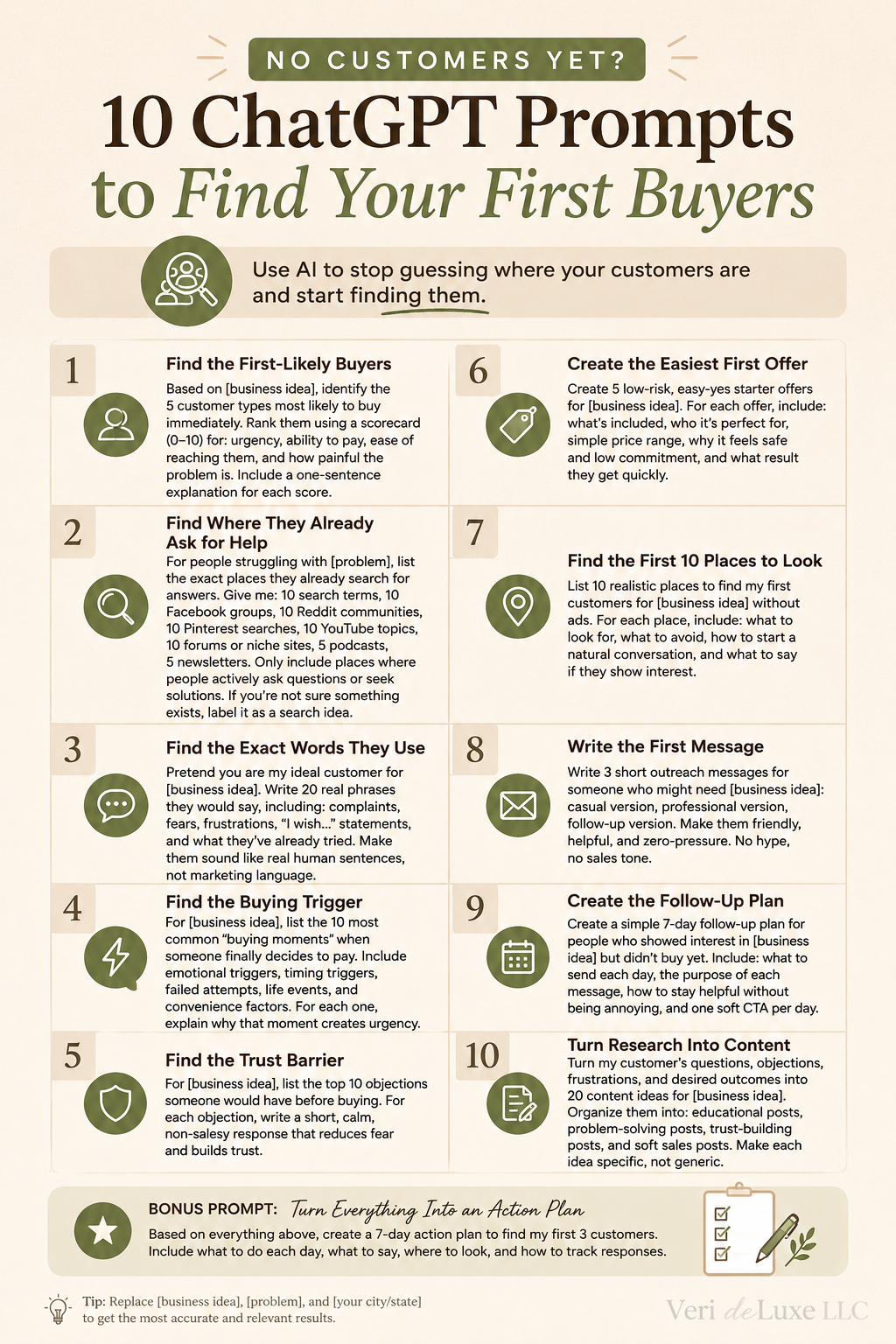
    The infographic below is a quick reference guide. Under it, you’ll find the full copy-and-paste prompts.

    No customers yet? 10 ChatGPT prompts to find your first buyers

    Quick Tip: The more information you give ChatGPT, the better the results. Include your business idea, location, budget, experience level, and ideal customer whenever possible.

    Important: If ChatGPT is not certain a group, podcast, newsletter, website, or community exists, ask it to label it as a search idea instead of presenting it as fact. That helps you use the ideas as research leads instead of assuming every result is verified.

    1. Find the First-Likely Buyers

    Instead of asking who might buy someday, focus on who would be most likely to buy first.

    Copy & Paste Prompt:

    Based on [business idea], identify the 5 customer types most likely to buy immediately. Rank them using a scorecard (0–10) for urgency, ability to pay, ease of reaching them, and how painful the problem is. Include a one-sentence explanation for each score.

    2. Find Where They Already Ask for Help

    Your customers are probably already looking for answers somewhere. This prompt helps you find places to research.

    Copy & Paste Prompt:

    For people struggling with [problem], list the exact places they already search for answers.

    Give me:

    • 10 search terms
    • 10 Facebook group ideas
    • 10 Reddit community ideas
    • 10 Pinterest searches
    • 10 YouTube topics
    • 10 forums or niche websites
    • 5 podcasts
    • 5 newsletters

    Only include places where people actively ask questions or seek solutions.

    If you are not sure a specific group, podcast, newsletter, or forum exists, label it as a search idea instead of presenting it as fact.

    3. Find the Exact Words They Use

    Most businesses sound too polished. Real customers usually describe problems in plain, frustrated, messy language.

    Copy & Paste Prompt:

    Pretend you are my ideal customer for [business idea].

    Write 20 real phrases you would say, including:

    • complaints
    • fears
    • frustrations
    • “I wish…” statements
    • what you’ve already tried

    Make them sound like real human sentences, not marketing language.

    4. Find the Buying Trigger

    People rarely buy randomly. Usually, something pushes them from “maybe later” to “I need help now.”

    Copy & Paste Prompt:

    For [business idea], list the 10 most common buying moments when someone finally decides to pay.

    Include:

    • emotional triggers
    • timing triggers
    • failed attempts
    • life events
    • convenience factors

    For each one, explain why that moment creates urgency.

    5. Find the Trust Barrier

    Before someone buys, they usually have concerns. This prompt helps you find those concerns before they quietly lose interest.

    Copy & Paste Prompt:

    For [business idea], list the top 10 objections someone would have before buying.

    For each objection, write a short, calm, non-salesy response that reduces fear and builds trust.

    6. Create the Easiest First Offer

    Sometimes your first offer should be smaller, simpler, and easier to say yes to than your main offer.

    Copy & Paste Prompt:

    Create 5 low-risk, easy-yes starter offers for [business idea].

    For each offer include:

    • what’s included
    • who it’s perfect for
    • simple price range
    • why it feels safe and low commitment
    • what result they get quickly

    7. Find the First 10 Places to Look

    Instead of posting everywhere and hoping someone notices, use ChatGPT to help you narrow down where to look first.

    Copy & Paste Prompt:

    List 10 realistic places to find my first customers for [business idea] without ads.

    For each place include:

    • what to look for
    • what to avoid
    • how to start a natural conversation
    • what to say if they show interest

    8. Write the First Message

    Many people know who to contact, but they freeze when it is time to write the message.

    Copy & Paste Prompt:

    Write 3 short outreach messages for someone who might need [business idea]:

    • casual version
    • professional version
    • follow-up version

    Make them friendly, helpful, and zero-pressure.

    No hype. No sales tone.

    9. Create the Follow-Up Plan

    Most people do not buy after the first interaction. A simple follow-up plan helps you stay helpful without being annoying.

    Copy & Paste Prompt:

    Create a simple 7-day follow-up plan for people who showed interest in [business idea] but did not buy yet.

    Include:

    • what to send each day
    • the purpose of each message
    • how to stay helpful without being annoying
    • one soft CTA per day

    10. Turn Research Into Content

    Customer research should not sit in a notebook. Turn the questions, objections, and frustrations into useful content.

    Copy & Paste Prompt:

    Turn my customer’s questions, objections, frustrations, and desired outcomes into 20 content ideas for [business idea].

    Organize them into:

    • educational posts
    • problem-solving posts
    • trust-building posts
    • soft sales posts

    Make each idea specific, not generic.

    Bonus Prompt: Turn Everything Into an Action Plan

    Once you have completed the prompts above, use this one to tie everything together.

    Copy & Paste Prompt:

    Based on everything above, create a 7-day action plan to find my first 3 customers.

    Include:

    • what to do each day
    • what to say
    • where to look
    • how to track responses

    Final Thoughts

    Many new businesses spend months building before they spend enough time finding buyers.

    Use these prompts to understand who your customers are, where they spend time, what they care about, and how to start conversations that may lead to sales.

    You do not need thousands of customers right away.

    You need your first few buyers. Start there.

  • Ask AI These 10 Questions Before You Start a Small Business

    Ask AI These 10 Questions Before You Start a Small Business

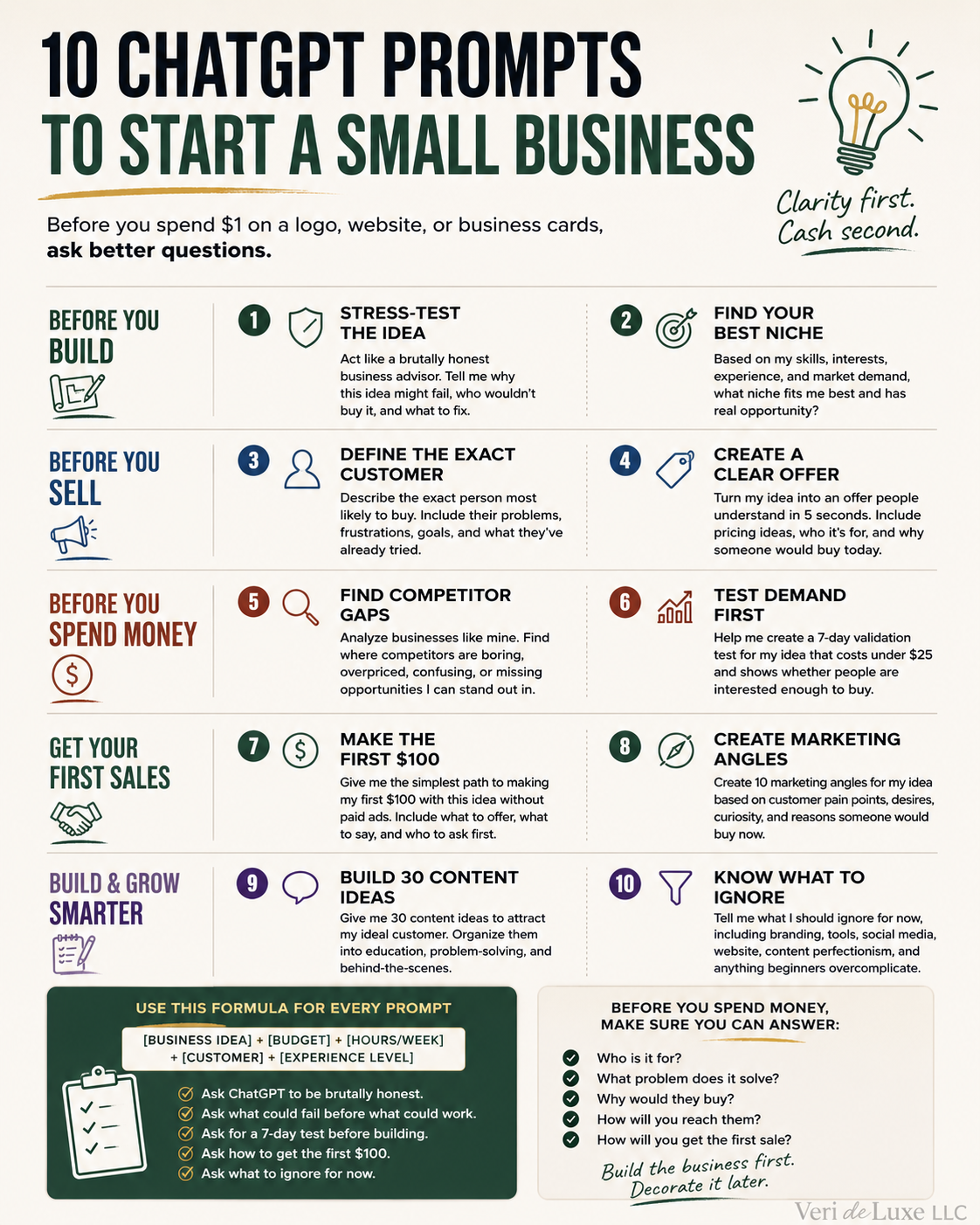
    10 ChatGPT Prompts to Use Before Starting a Small Business

    Most new business owners spend time worrying about logos, websites, business cards, social media accounts, and brand colors.

    The problem?

    None of those things tell you whether people want what you’re selling.

    Before you spend money, use ChatGPT to pressure-test your business idea, understand your customer, and focus on the things that matter most.

    10 ChatGPT prompts to start a small business before spending money

    Quick Tip: The more details you give ChatGPT, the better the answers. Include your business idea, budget, experience level, available time, and target customer whenever possible.

    1. Stress-Test the Idea

    Before you fall in love with an idea, let ChatGPT try to break it.

    Copy & Paste Prompt:

    Act like a brutally honest business advisor. I want to start [business idea]. Tell me why this might fail, who would not buy it, what people would complain about, and what I should fix before spending money.

    2. Find Your Best Niche

    Sometimes the best business is not your first idea.

    Copy & Paste Prompt:

    Based on my skills, interests, experience, budget, and time available, give me 10 small business niches that fit me. Rank them by startup cost, demand, competition, profit potential, and ease of getting customers.

    3. Define the Exact Customer

    A business for everyone usually sells to no one.

    Copy & Paste Prompt:

    Based on this business idea: [business idea], describe the exact person most likely to pay for it. Include their problem, frustrations, what they want instead, what they have already tried, and what would make them buy.

    4. Create a Clear Offer

    People buy solutions, not vague ideas.

    Copy & Paste Prompt:

    Turn my business idea, [business idea], into a clear offer people understand in 5 seconds. Include pricing ideas, who it is for, who it is not for, and why someone would buy today.

    5. Find Competitor Gaps

    Do not copy competitors. Find what they are missing.

    Copy & Paste Prompt:

    Analyze businesses like mine. Find where competitors are boring, overpriced, confusing, too generic, or missing opportunities. Give me practical ways to stand out.

    6. Test Demand First

    A logo is not validation. A website is not validation. Likes are not validation.

    Copy & Paste Prompt:

    Help me create a 7-day validation test for [business idea] that costs under $25 and shows whether people are interested enough to buy.

    7. Make the First $100

    Your first sale teaches you more than months of planning.

    Copy & Paste Prompt:

    Give me the simplest path to making my first $100 with [business idea] without paid ads. Include who to contact, what to offer, what to say, and what to do if no one responds.

    8. Create Marketing Angles

    Give people a reason to care.

    Copy & Paste Prompt:

    Create 10 marketing angles for [business idea] based on customer pain points, mistakes, frustrations, desired outcomes, curiosity, and reasons someone would buy now.

    9. Build 30 Content Ideas

    Never stare at a blank screen again.

    Copy & Paste Prompt:

    Create 30 content ideas for [business idea]. Organize them into education, problem-solving, behind-the-scenes, customer mistakes, product or service benefits, comparison posts, and sales posts.

    10. Know What to Ignore

    One of the hardest parts of starting a business is knowing what not to do.

    Copy & Paste Prompt:

    Tell me what I should ignore for now, including branding, tools, social media, website, paperwork, content, perfectionism, and anything beginners overcomplicate.

    Final Thoughts

    ChatGPT cannot guarantee a successful business.

    What it can do is help you ask better questions before you spend money.

    Use these prompts to challenge assumptions, identify weaknesses, understand customers, and focus on the work that matters most.

    Build the business first. Decorate it later.